


- REVIEWS
Camera Reviews 
More Reviews Mobile Reviews Photography Reviews - GALLERIES
- VIDEOS
- BUYER'S GUIDES

Mamiya Press; A Medium Format Rangefinder Camera
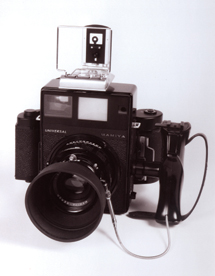
There were two models of the versatile Mamiya Press medium format rangefinder cameras in the 1960s and '70s, the Universal Press and the Press Super 23. These cameras were designed to be more compact and in many respects more versatile than the bellows type 4x5 and 2x3 press cameras of that era, such as the Speed Graphic, Busch Pressman, and Linhof Technica. The main competition included the very similar looking Graflex XL and XLRF and the Linhof Press 70 rollfilm cameras, which also had interchangeable lenses and rollfilm backs. The Mamiya interchangeable lenses all coupled to the camera's internal rangefinder for accurate focusing and their bayonet mounts mated directly to the large opening in the body, making a more rigid and rugged camera. To compensate for the typically inaccurate viewfinders found on most rangefinders, the Mamiyas had etched markings in the viewfinder that indicated the field covered. These moved as the lens was focused to provide a more accurate representation of the exact area that would record on the film.
 |
|
|
The Universal Press is basically a square metal box with a large circular opening on the front for the interchangeable lenses and a large square opening in the back, which accepted a variety of rollfilm backs or a Polaroid instant print film back. The top of the box contains a built-in, eye-level viewfinder and a removable pistol grip that attached to the left side. Put all the components together and you had a formidable and versatile medium format camera, light enough for handheld photography or use in the studio on a tripod.
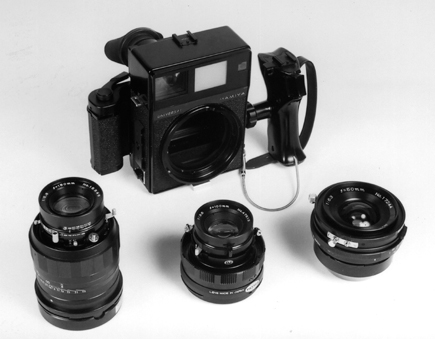
There were 12 different Mamiya Sekor lenses, ranging from 50mm wide angle up to 250mm telephoto. Since some focal lengths had 2-4 versions with varying maximum lens apertures and either chrome or black finish, there were actually only seven different focal lengths: 50, 65, 75, 100, 127, 150, and 250mm. Filter sizes ranged from 40.5-105mm. The broad, impressive system included a selection of 120/220 roll backs, cut film and film pack backs, and, for the Universal Press model only, a Polaroid pack film holder. The system included several very helpful side grips, optical finders for the wider angle lenses, wire frame sports finders, and mounting brackets compatible with common flash guns of the era. For close-up work there were both extension rings for use between the lens and body plus spacer sets to extend the back and a focusing hood with a ground-glass back for the precise focusing and composition, needed when doing close-ups.
This camera came from the era when all cameras were completely manual in operation, thus the user had to be knowledgeable and adept at making needed adjustments. Metering was done either with a handheld light meter, or by estimating the lighting conditions and setting the exposure. Fortunately, the black and white and color negative films used back then were forgiving in exposure latitude, so some exposure error still resulted in a usable negative.
 |
|
|
Each of the bayonet mount, interchangeable lenses coupled to the camera's built-in rangefinder for precise focusing. The camera's viewfinder had internal masking adjustable for the more common 100mm (normal), 150mm, and 250mm telephoto lenses; for each of the three wide angle lenses an external viewfinder that fit onto a shoe on the top of the camera was needed for more accurate composing. The actual size of the camera's viewfinder view never changed; instead bright marks that vividly show in the viewfinder indicate the four corners of the field of each lens.
| |||||||||
|

| ||||||||
- Log in or register to post comments






















 FEATURED VIDEO



Get the Latest Photo Tips, News & Reviews from Shutterbug!







| Camera Reviews Other Reviews | |
Mobile Reviews Photography Reviews Columns | |
News | |
Features | |
How-To | |
Resources |
 © 2024 Shutterbug
AVTech Media Americas Inc., USA
All rights reserved