| |
Retina
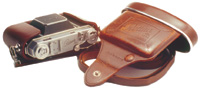
IIa on the half shell. I don’t normally use ever-ready
cases but for this one I’ll make an exception. The
flap is detached for clarity.
|
|
Fit And Finish
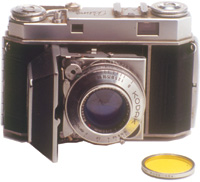
It is tiny: about 120mm (43/4”) long, 84mm (31/4”) high, and
43mm (15/8”) deep (folded). Erected, it’s about as deep as
it is high (84mm/31/4”). It weighs about 540 gm, just over 19 oz.
It is very well finished. The leather of the front panel is stamped “Kodak,”
while the back says “Kodak Retina Camera, Made in Germany.”
The satin-chrome top is beautifully engraved “Retina IIa”
and the wind-on lever is polished light alloy with a leather insert. With
the “clam-shell” front door closed, you can stick the bare
camera in a shirt pocket, but the real leather, plush-lined, metal-trimmed
ER case (embossed “Retina IIa”) adds so little bulk and offers
so much protection that it’s hard to resist using it.
Cleverly, both the camera and the ER case have strap lugs, so the same
strap can be used with either—and the strap (of course) is of the
highest quality, real leather, with locking clips so they can’t
come undone. The front can be removed—push the rear press-stud upward—so
you can use the camera in the half case.
Lens Quality
Mine has a coated 50mm f/2 Rodenstock Retina-Heligon, while US imports
mostly (maybe all) had the 50mm f/2 Schneider Xenon. Both are excellent.
Coating greatly increases contrast and reduces flare, and I think my last
IIa was uncoated. Coating is particularly important in a folding camera,
where lens shades are often neglected because you have to take them off
before you can close the lid. The diaphragm pointer, click-stopped at
whole stops from f/2 to f/16, is nonlinear: f/2 and f/2.8 are a long way
apart and f/11 and f/16 are uncomfortably close together.
The filter size is marked as 32mm (the push-on size) but the thread is
29.5mm. You can close the camera with an ultra-slim Kodak Retina filter
in place—or if you have access to a time machine, go back about
45 years to your nearest Ednalite dealer. My Ednalite Retina F:2.0 to
Series VI adapter has a price of $2.85 printed on the box.
Shutter Specs
The shutter is a Synchro-Compur with the old speed sequence: 1, 1/2, 1/5,
1/10, 1/25, 1/50, 1/100, 1/250, 1/500 sec. Obviously this is less convenient
than the modern “halveable” sequence of 1, 1/2, 1/4, 1/8,
1/15 sec etc., but it’s less important than you might think. The
big gap is 1/10 to 1/25 sec, but apart from this, the other marked speeds
are within 1/3 stop of their modern equivalents. It’s very, very
quiet: it makes an M-series Leica sound noisy.
The 1/500 speed is stiff to set: it is advisable (and easier) to set it
before winding on, rather than after. There’s switchable X (electronic)
and M (bulb) sync, but no V (self-timer) setting. Prior to July 1951 the
shutter was a Compur-Rapid.
The actual speeds on my camera, tested with my ZTS Tester Pro, are a bit
off. They are more than accurate enough for negative film, erring always
on the side of overexposure, but for color slides, you would need to compensate:
-1/3 stop from 1/10 to 1/50, -2/3 stop for 1/100 and 1/250, and - 1 stop
for 1/500. Remember that my camera is around half a century old and has
probably never been cleaned. Speeds could be restored to rather better
accuracy, though the 1/500 is unlikely to have been faster than 1/400
when the camera was new.
Film Loading And Handling
Now, let’s put a film in it. Fold down the catch on the end of the
door, and the back swings open. Pull the rewind knob up all the way, and
loading is easy enough. The wind-on lever has a throw of about 190Þ
and cannot be “inched”; it must be pushed all the way before
it will return. There’s also zero stand-off: the lever must be pushed
home before the shutter release is freed. The very last part of the throw
is slightly stiffer than the rest, especially at 1/500 sec.
The subtractive frame counter must be reset manually. For a 36-exposure
film, there’s a diamond mark between 0 and 35; for 20-exposure film,
it’s at frame 23. The shutter release won’t operate with the
front closed, so a little button behind the shutter release allows you
to wind and fire without opening, to get to the start of the film. Frames
are numbered 0-5-10 etc. and are reasonably easy to read even for aging
eyes. After frame 1 the camera locks solid until the counter is reset:
no chance of frame 37 on this one.
The only other control on the top plate is the pull-up rewind knob, which
incorporates a film reminder: “Color Tageslicht” (daylight),
“Color Kunstlich” (artificial light), and “Pan”
with DIN speeds of 13-15-17-19-21-23. DIN 23 equates more or less to ASA
320, a
super-speed film for 1952—though in the early 1950s, black and white
films incorporated a one stop “safety factor” so ASA 320 equates
more or less to a modern ISO 640 (or indeed, a post-1959 ASA 640). At
the other end of the scale, DIN 13 is a searing ASA 32, call it ISO 64.
Not that it matters: it’s a reminder only, and there’s no
meter. The top plate is rounded out with the accessory shoe, which is
not “hot”: there’s a PC nipple on the shutter.
On the bottom of the camera there’s a press-button to open the door.
On the case, there’s a corresponding button to transfer the pressure
from the case to the camera. Press, and the door springs open partway.
Pull it out until it clicks, and the camera is ready for action. The door
moves a little, but this doesn’t matter: it’s not an integral
part of the front standard, which is essentially a doppel-klapp.
Also on the bottom is the rewind clutch, with revolving dot. You’ll
need to push this in (and to take the camera out of the ER case to do
so) when you want to rewind. The tripod socket is a standard quarter-inch
Whitworth, 0 BA, at the right-hand side of the camera as you hold it ready
for use.
Focus Control
Focusing is via a lever beside the lens, in the bottom right-hand corner
(seen from the front) at infinity. A 90Þ movement (anticlockwise,
or upward) brings you to the closest focus of approximately 3 ft, 90cm.
Focusing must be reset to infinity before you can close the camera, squeezing
in the little studs above and below the shutter in order to free the folding
mechanism.
My camera is scaled only in meters, but I’m reasonably sure there
were either feet-meter or feet-only versions as well. There is no parallax
compensation in the viewfinder, so you have to rely on experience—or
use a separate, accessory finder. I used to have a 50mm Leica finder with
my last IIa but in a moment of stupidity I sold it. If you wear spectacles,
leave them on: they will make the finder much easier to use.
The rangefinder base is about 43mm (1.7”), more than adequate for
a 50mm f/2 lens. A fairly tiny depth of field scale is engraved on the
focusing mount: the lens is fixed, as it was on all Retinas prior to the
IIc/IIIc.
Shooting Test
And that’s it. No more controls. This is, as I said, a purist’s
camera. You have to use a separate meter, or guess exposure. Out of deference
to its ancestry, instead of putting my usual Ilford HP5 Plus into it I
loaded it with Kodak’s Tri-X—a film which was introduced at
around the same time as the Retina IIa, though today’s Tri-X is
a very much cleverer film than the Tri-X of 50 years ago (or even five
years ago).
The results? Initially, a disaster. I hadn’t noticed that some previous
owner had re-blacked the film gate with gloss paint, leading to terrible
flare lines along the long sides of the image. Also, I hadn’t checked
the speeds at that point, so the negs were overexposed. Once I remedied
both these problems, they were superb. In the sort of pictures I took,
you couldn’t even tell the difference between this and the state
of the art Voigtländer lenses on my R2. This is a real “user’s
classic” that offers a combination of features—compactness,
lens speed, and total battery independence—impossible to find on
a modern camera. Also, it is affordable: few Retinas, except the very
last “little c” and “big C” models, attract much
collector interest.
What To Pay?
Price? Well, as with any “classic” camera that doesn’t
attract too much investor interest, a very great deal will depend on where
you buy it; what the seller thinks it is worth; and what it’s worth
to you. I have seen them in dealers’ advertisements for well over
$100—sometimes close to $200—but if you are really lucky you
may find one at a yard sale for a few dollars because it’s “just
a Kodak.” Personally, I’d not be inclined to pay over about
$100 for one, but if this one had been $60 or even $75, I think I’d
have bought it anyway. This probably means that a fair price is in the
$100-$120 range.
They are not particularly uncommon, so you can afford to wait for one
at a price you like. Unfortunately, production figures are lumped together
with the knob-wind Retina II Type 011 (1946-49), but Kodak made 268,000
of the two models together. There were probably over 150,000 IIa models.
As it was, I got lucky. As they said in the shop, “Yes, it works,
but it is a collector camera and we do not guarantee it.” So they
sold it to me for 15 Euros, about $16.50.
|