


- REVIEWS
Camera Reviews 
More Reviews Mobile Reviews Photography Reviews - GALLERIES
- VIDEOS
- BUYER'S GUIDES
Buyers Guide To Tripods
Choosing Different Pods For Different Jobs
As there's no such thing as the one perfect camera for all photographic pursuits, there's also no one perfect tripod all camera support tasks, although I'll admit to having taken a rather inordinately long time early in my photographic career coming to this conclusion. When you're new to photography, the tripod selection process usually comes upon you in stages. First is the spark of awareness that you actually need a tripod, often as not inspired by lots of pictures that aren't as sharp as they could be. But a major reason you bought a 35mm SLR in the first place was so that you wouldn't be burdened with a tripod, right? So your first 'pod is the lightest one you can find, enough to feel you've "done your duty," but with little serious consideration before the purchase as to what physical requirements need to be met. Therefore, as soon as you acquire either a lens with a focal length longer than 135mm, or a larger format camera, you're in the market for a tripod again. Your second adventure in tripod land is likely to follow one of two scenarios, depending on your particular psyche: either a 'pod that's just heavier enough to accommodate your new lens or camera, setting yourself up for yet another tripod purchase not far down the road, or you go nuts and buy a 30 lb behemoth on the "get it over with" theory that there's no camera it can't handle. The latter is fine for studio work, but on location you won't be able to drag it much more than 100' from your SUV. |
|||
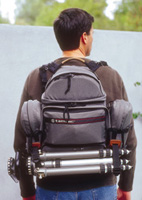
A Tale Of Two Tripods In practice, though, it's a good deal more complicated than these simple criteria would indicate. And while your specific photographic circumstances will probably differ from mine, the comparative process that I engaged in to identify my shooting needs and match my tripods to them accordingly may prove instructive. I tend not to backpack cameras larger than medium format, so compactness is a factor considered only for my smaller tripod. I insisted on a 6' height when fully extended, to ensure comfortable, eye-level camera viewing. Conversely, I also wanted absolute ground-level shooting capability; this necessitates either a reversible column, a column with a mounting screw on both ends, or the use of an accessory side arm (more to lug). Rigidity, of course, was paramount, as all other features are instantly negated if the 'pod can't hold your camera rig steady. This is where your particular shooting habits will dictate the minimum acceptable mass (weight) and torsional stiffness. If, for instance, you regularly use extreme telephoto lenses under windy outdoor conditions, you can't afford to compromise in the sturdiness department. I seldom use lenses longer than 250mm focal length, so that was my small 'pod selection yardstick. When I need an extreme tele, an accessory bracing arm (e.g., Bogen or Kirk Enterprises) works fairly well (only with static subjects, as you can't follow action this way) up to about 700mm; my 1250mm "cat" requires my bigger tripod. |
|||
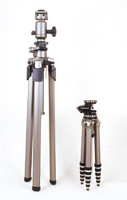
So what tripod met my needs for smaller format work? A six-section Gitzo Studex, fitted with a compact three-way Linhof head. It's compact (20" collapsed with head, 16.5" without); tall enough (73" fully extended, with the Linhof head); has a reversible, two-section, "rapid"-type column; legs that will spread flat; rigidity is superb. Weight, with head, is about 8 lbs, obviously not a lightweight for its size. Gitzo discontinued this model shortly before I decided on it, approximately 12 years ago, but I eventually tracked one down. If it was so good, why was it discontinued? Because its greatest asset (6' extended height, along with very compact collapsed dimensions) was also its greatest drawback. To fully extend this six-section 'pod, including the two-section column, requires the operation of 17 ring locks, times two to collapse it again! It's a time-consuming pain, but the only way to have my cake and eat it too, so I put up with it. It has served me flawlessly as my location and backpacking tripod, and I still haven't found anything superior for the purpose assigned it. |
|||
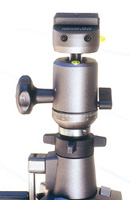
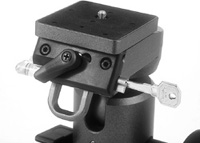
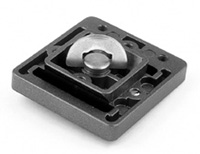
Larger Camera 'Pods My choice? A Cullmann Titan CT 400, with their CT 50 pro ball head. With only two leg sections, all it takes is a flip of the lever atop each leg, let gravity do its thing, and you're ready to attach your camera. The leg sections are reversed, with the larger diameter one at the bottom. This provides a greater contact area with the floor or ground, and offers waterproof operation (e.g., no crud in the locks) in streams up to the top/bottom leg joint. A downward pull on the head's U-shaped quick-release stirrup opens the mechanism to accept the mating plate on your camera (the plate's tripod screw has a flip-up semicircular grip, no coins necessary); a lever then locks it securely. A keyed insert can be used to lock the plate to the head as a theft deterrent (a thief would have to beat feet with the camera still attached to the tripod; with this 'pod, he won't be making very good time). |
|||
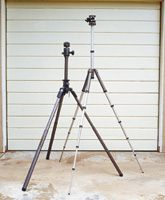
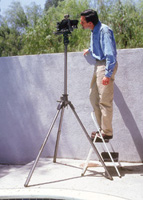
Another plus is the serrated surface common to the tripod's mounting plate and the bottom of the head. This prevents any twisting motion from inadvertently loosening the head. The CT 50 head has totally different controls for the pan and ball movements, precluding any confusion when making compositional adjustments while looking through the camera. Geared column lift precisely maintains the camera's established compositional orientation, especially appreciated in conjunction with view camera lens movements. The circular and tubular levels provided come in handy with the panoramics that comprise a major portion of my photography. Surprisingly to the uninitiated, my compact Gitzo extends higher than the looming Cullmann Titan. But add the accessory CT 64 long column and the Cullmann lifts your 4x5 into stepladder territory. This facility lets me achieve a high perspective in the studio without having to resort to (and shuck out for) a studio camera stand. It's also a big help when shooting landscapes in flat terrain; you'd be surprised what a mere 3' of additional shooting height beyond standing eye level can do pictorially in such circumstances. |
|||
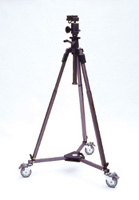
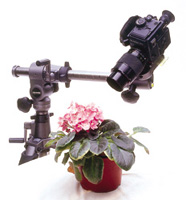
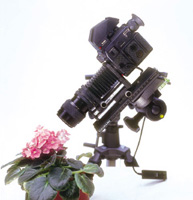
Cullmann's accessory list equips the CT 400 for versatile studio use. I particularly relish the camera positioning options afforded by the CT 60 Makro Insert, in combination with an additional geared column. I frequently use this setup to place my camera out over the surface of my product table, a positioning unattainable with a tripod alone. The CT 75 dolly adds mobility when needed. I've had the Cullmann for a couple of years now, and it has contributed quite significantly to speeding up my large format camera usage. So that's how I came to have the two tripods that I do. They match my specific requirements as perfectly as possible, and I wouldn't part with either of them. I occasionally need a table tripod, monopod, beanbag, or a suction-grip device, but these two very different tripods cover 95 percent of my shooting needs. There are many other fine tripods, of course, and one or more of them may suit your needs better than the pair I ended up with. The point is to do your homework thoroughly, with an eye to both present and near-future camera/lens equipment. Don't fret trying to foretell the future 10 years down the road, but think ahead far enough to avoid buying a near-term white elephant. I should also point out that Gitzo offers equivalents of most of the accessories that I acquired for the Cullmann; it's just that for my purposes (backpacking, location work) I didn't need them. |
|||
Points To Ponder When Shopping For A Tripod |
|||
|
|||
Manufacturers/Distributors |
|||
|

| ||
|
||


 FEATURED VIDEO


Get the Latest Photo Tips, News & Reviews from Shutterbug!







| Camera Reviews Other Reviews | |
Mobile Reviews Photography Reviews Columns | |
News | |
Features | |
How-To | |
Resources |
 © 2026 Shutterbug
AVTech Media Americas Inc., USA
All rights reserved