


- REVIEWS
Camera Reviews 
More Reviews Mobile Reviews Photography Reviews - GALLERIES
- VIDEOS
- BUYER'S GUIDES
Snob Appeal
35s With A Touch Of Class
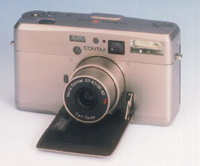
Just as few people actually need a luxury car for transportation, they feel that getting there with impeccable performance in elegance and style greatly enhances the experience. For the same reason, some photographers own one of the luxurious titanium or other alloy-bodied lens/shutter 35mm cameras with built-in lens. These offer superior craftsmanship and high-precision mechanisms. Keeping with the automotive analogy, they are the BMW and Lexus models of the camera culture. In addition to some intangible qualities, these upscale cameras incorporate premium-grade optics, helping to justify the high price. In most cases, the gorgeous exterior hides a tough, metal alloy body for maximum rigidity. Some models' body panels are made of titanium--for high strength, reasonably lightweight, scratch resistance plus a beautiful lustrous finish. Naturally, the ultimate in quality does not come cheap. But when only the very best will do, these models will surely satisfy even the most discriminating photographer. Note: Several manufacturers also offer 35mm interchangeable-lens rangefinders with a metal body and high prestige value. I'll cover these briefly in a sidebar. Contax Duo |
|||
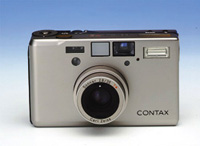
The autofocus system is quite fast and it's versatile, too. Select wide area AF for quick shooting or spot AF for pinpoint focus control; manual scale focusing with electronic guidance signals is also available. Thanks to a focus assist illuminator lamp, the passive AF system works well in low light, too. Zoom operation is motorized. A "real-image" finder assures accurate framing and helps to prevent parallax error in close focusing. Camera operation is logical and simple, with very large, well-marked wheels, dials, and buttons. Apertures are now selected with a button, instead of an f/stop ring, but this works just fine. The viewfinder display is extensive and includes the shutter speed. The second Contax model is the gorgeous titanium T3 with premium-grade 35mm lens that accepts 30.5mm filters with an adapter. Since metering is not TTL, set a plus exposure compensation value for correct exposure with darker filters. Although the T3 has multimode built-in flash, you can also buy an optional SA-2 flash adapter for attaching an accessory TLA 200 flash unit for extra power output. The camera can be set to fire either, or both, flash units. The Contax T3 allows for manual focus, although no distance scale is provided. Allow the AF system to set focus first; then, check the distance information in the LCD panel and change focus if desired. The wide area AF system is passive, great for low-light photography. A wide range of shutter speeds is available; switch to the LT mode and you can select incredibly long (metered) speeds: up to a full 3 minutes. No matter which model you prefer, superb fit and finish help to make the stylish Contax camera a pleasure to own. |
|||
Leica Minilux Duo |
|||
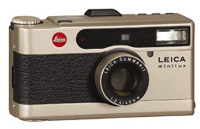
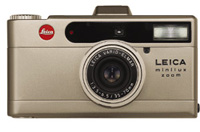
The Minilux Zoom is a very similar titanium-clad model with high-grade zoom lens and zooming Real-Image viewfinder. This one offers a bonus: a hot shoe that accepts an accessory shoe-mount Autoflash unit for increased flash range. Its controls include a large wheel plus small buttons which must be pressed often to access various features. Built for long-term reliability, both models are meticulously engineered and crafted, as befits any camera bearing the red Leica badge. |
|||
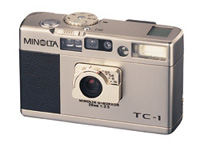
Minolta TC-1 Operation is both simple and convenient thanks to the well-marked controls, especially the oversized mode selector dial. A choice of four f/stops can be made for depth of field control, using a mechanical retro-look switch next to the lens. The three-point AF sensor and focus assist lamp make autofocus operation reliable even in low light. Manual focus (with 26 zone settings) is selected with the multifunction dial and adjusted with a selector lever. Guidance is provided by an analog distance scale in the viewfinder, which also displays a lot of other data. The TC-1 has a different set of features than most of its direct competitors, but is well specified overall as indicated in the "35mm Lens/Shutter Compact Cameras" sidebar. In addition to the capabilities mentioned, it has a Real-Image viewfinder with aspherical lens for a clear, accurate view. Minolta has proven that a titanium 35mm model of high optical and mechanical quality can be as small and light as a plastic camera. |
|||
Ricoh GR-Series |
|||
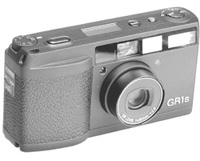
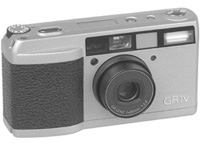
The black GR1v is nearly identical to the GR1s but offers a few extra capabilities as noted in the "35mm Lens/Shutter Compact Cameras" sidebar. All of the GR-series cameras show shutter speed, shooting mode, and any exposure compensation setting in the viewfinder. The most recent Ricoh model, the GR-21, resembles the GR1v but features an ultra-wide 21mm aspherical lens. This camera also accepts filters and has a socket for a cable release and for a PC cord; the latter allows the use of an accessory non-TTL flash unit or a studio flash system. All of the GR cameras are surprisingly compact, thin, lightweight, and classy. De-signed for speed and simplicity of operation, they include some advanced capabilities making them suitable for serious photography. |
|||
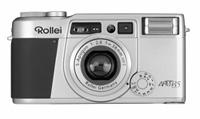
Rollei AFM35 Small, solid, and well-balanced, the Rollei AFM35 is an automatic camera with all the essentials plus autoexposure bracketing, Aperture Priority AE for depth of field control, plus a passive autofocus system and focus assist beam. It also includes a 10 zone manual focus option, set with a unique front-mounted dial. This is a great-looking model that's clearly of European design and it offers full versatility, a high grade lens, and fine mechanical quality for lasting value. |
|||
Rangefinder Models With
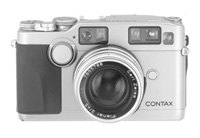
High Prestige Value Autofocus Contax: An autofocus rangefinder camera, the Contax G2 offers an elegant look and feel with a traditional design and lustrous titanium body cover. Inside, it's very rugged with an aluminum alloy chassis that will withstand harsh conditions. Although loaded with high-tech capabilities, the G2 sports some old-style controls, plus manual focus and a PC terminal that will appeal to long-time photographers. They'll soon appreciate its advanced capabilities: four operating modes, overrides, 4 fps film advance, zooming viewfinder, 1/6000 sec top shutter speed, TTL flash metering, and other features. |
|||
Kyocera is convinced that the G2 and the seven superb Carl Zeiss G-mount lenses will satisfy professional photographers, but it's not reserved exclusively for that group. In fact, advanced hobbyists would do well to check it out. It's truly a gem, even if the full system is priced like one. (Street Price: $1700, body only.) Professional quality rarely comes cheap and the Contax G2 system will surely satisfy the most discriminating photographer. |
|||
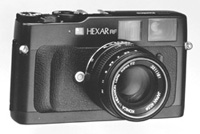
Rugged Konica Duo: The Konica Hexar rangefinder is an appealing camera, with its die-cast aluminum chassis, black finish, and titanium covers. This is a fairly conservative model with Manual and Aperture Priority AE mode but it includes a top shutter speed of 1/4000 sec plus built-in film advance motor for continuous shooting at 2.5 fps. Its KM bayonet mount accepts Konica lenses as well as others with M-mount. The rangefinder/viewfinder with automatic indexing lines for lenses from 28-135mm offers automatic parallax compensation. (Street Price: $1100.) |
|||
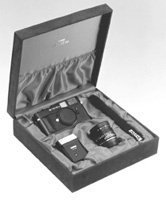
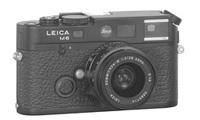
For greater prestige value, consider the Hexar RF Limited outfit. Basically the same camera, this model boasts silver-tone titanium covers and a matching 50mm f/1.2 lens plus pouches in a presentation case. If you're interested in this model, don't delay because the silver 50mm lens is available only in the limited edition outfit. All other Konica M-lenses are black. Only 2001 units of this kit were manufactured, so the limited model certainly offers great exclusivity. (Street Price: $2600.) Leica M-series: Leica's exacting standards of quality control and meticulous craftsmanship combine to produce robust, beautifully finished equipment that holds the potential for a lifetime of photography. The Leica designers have always taken a conservative approach to upgrades of the M-series models, since the first M3. |
|||
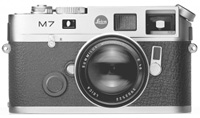
This spring, Leica released the new M7. (Street Price: $2450.) Notable new capabilities include Aperture Priority AE, exposure compensation control, automatic film speed setting if desired, new type of dual-image focusing aid, plus electronically controlled shutter. At 1/60 and 1/125 sec, the shutter is mechanically controlled, so the camera will operate even if batteries fail. With a specially equipped Metz 54-MZ3 flash unit, high-speed flash sync is available, as well as second curtain sync. Almost identical in appearance to the M6, the Leica M7 is available in black and in silver. Both cameras are available in several models with various viewfinder magnifications. Nikon Rangefinder: Nikon introduced a rangefinder in 2000, the Nikon S3 with Nippon Kogaku Toyo icon. A limited edition model, only 2000 were made but you should still be able to find one. This model recreates the S3 rangefinder first produced in 1958, and is a very close copy of that classic camera. Hence, it's not surprising that the S3 2000 does not include a meter and that film loading calls for removing the baseplate. Although this is a nostalgic camera that seems odd by today's standards, the current S3 is fully useable and is not merely a collector's item. Beautifully constructed and finished, this all-metal camera is heavy at 1.8 lbs. It features a full-size viewfinder with framelines for 35mm and 135mm lenses, split-image rangefinder patch, and old-style controls including an index finger focusing wheel, a "cold" shoe for flash plus a PC cord socket. The lens mount accepts both Nikon and Contax rangefinder lenses of the past; it's sold in a kit with a new 50mm f/1.4 lens and eveready case. Because this is not a mass production camera, the price is, understandably, steep but that will help to assure a measure of exclusivity. (Street Price: Under $4500 for the kit.) 35mm Lens/Shutter Compact
Cameras Conclusion Manufacturers/Distributors |
| ||
|
||


 FEATURED VIDEO


Get the Latest Photo Tips, News & Reviews from Shutterbug!







| Camera Reviews Other Reviews | |
Mobile Reviews Photography Reviews Columns | |
News | |
Features | |
How-To | |
Resources |
 © 2026 Shutterbug
AVTech Media Americas Inc., USA
All rights reserved