


- REVIEWS
Camera Reviews 
More Reviews Mobile Reviews Photography Reviews - GALLERIES
- VIDEOS
- BUYER'S GUIDES

The Darkroom
The Darkroom In 2000 to 2001
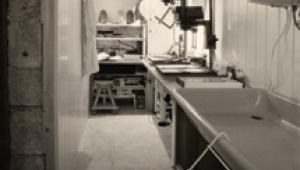
| While conventional photography (as opposed to digital) continues to be the main stream of the industry, conventional darkroom activity has declined over the past few years. Today, most conventional darkroom activity seems to be in the area of fine art images where archival image life is paramount. At one time a glossy "C" print was an absolute requirement if you were going to reproduce an image in a magazine or if you were going to print sales literature. Today, all of the pre-press work is being done digitally. So, providing the printer with an electronic file actually lowers costs and saves time as opposed to a glossy print that would just have to be scanned and converted to an electronic file before anything could be done with it anyway. But, if you are a fine art photographer, you probably are still wanting to do things the conventional way, in a wet darkroom where you will have the longest possible life from your color or black and white prints. Although great progress has been made with so-called archival inks for ink jet printers, there remains a lot of issues with the technology. For example, it is rather difficult to reproduce with the computer and ink jet printing, the rich cold-black tones of a well crafted black and white print in a wet darkroom. Black and white ink jet prints tend to have a touch of crossover with brown or green tones in the shadows. And, when printed with black ink only, they tend to have a reduced gamma compared to wet darkroom prints. Admittedly, these shortcomings in digital prints are subtle and would only be noticed by an experienced professional. Still, they are enough to cause serious professional fine art photographers to pause and think a bit before jumping into digital. Unfortunately, the market for wet darkroom equipment has decreased so dramatically in recent years that most manufacturers are reluctant to invest too heavily in the engineering effort required to bring new products to market. So, most of the wet darkroom products that are still available for use are the older, tried and true, designs that require little, if any, on-going engineering to continue their production. Make no mistake about it, most images are still being shot on conventional film and that film is still being processed in chemicals in some sort of a wet darkroom. However, at that point, a lot of that film is now being scanned into computers where the digital files are being sent directly to advertising agencies, pre-press houses, and other clients over telephone lines. If you are interested in making conventional wet darkroom color prints today, one choice would be to use a Beseler Dichroic Color Head and a Jobo Color Analyzer. Beseler offers three models of medium format color enlargers: the Printmaker Dichro 67; the 67XLD Dichro Color Enlarger; and their top of the line medium format machine, the 23CIII-XL Dichro Enlarger. The 23CIII is a modular unit that can be fitted with one of three different heads: a black and white Condenser head; a Dichroic head; and a black and white Variable Contrast head. In my opinion, it's the most bang for the buck in the industry today. If you want a more professional color enlarger, Beseler offers two different 4x5 chassis: the old standby 45MXT motorized chassis, and their top of the line 45V-XL chassis. Each chassis can be outfitted with one of two different color light sources: the Dichro 45S or the Universal 45 Light Source. The Universal 45 Light Source can be coupled with either a Color Controller for making color prints, or with a Variable Contrast Controller for making black and white prints. All dichroic color heads tend to be a bit unstable and have some color temperature drift to them. Therefore, if you want to be able to print with a minimum of wasted time, paper, and chemicals, you should use a good color analyzer to set the color filters on the color enlarger. Yes, all color light sources have little dials with numbers on them for setting the filters. That's nice. But, the quartz-halogen bulb that is used has way too much drift to it for doing very precise work. If you will use a good, solid-state, digital color analyzer for reading the color of light coming from the enlarger and use the analyzer readings for setting the enlarger's filter dials, you'll get much higher repeatability from the machine. Jobo makes probably the best color analyzers available today. Their ColorLine 7000 Analyzer is the top of the line and makes an excellent companion for any dichroic enlarger. Who knows, you might even learn how to analyze color negatives. But, if all you do is use it to set the filter dials, you'll get greatly improved accuracy. Now, to be sure, there are other manufacturers of enlargers and analyzers. I just happen to use the brands and models that I've described. Saunders, Omega, Durst, and Daylab all make great enlargers that compete with Beseler. Ilford makes a variable contrast light source that can be fitted to a Beseler or Omega enlarger chassis. Aristo makes several different cold-light diffusion heads that can be fitted to a Beseler or Omega chassis. If you want to process your own film, then I'd recommend a Jobo processor. Jobo makes a wide price range of film and print processing equipment. As the automation of the equipment increases and the ability for greater throughput from the equipment increases, the price also increases. But, somewhere in the Jobo line of film and paper processors there is probably something for almost everyone's needs. Of course, there are other companies besides Jobo that make film and paper processors: Durst, Fujimoto, Nova, Patterson, and Mohr Enterprise are some of the bigger companies that also produce film and paper processing equipment. Dunwright & Vogel makes some of the best print and film washers available. If you're new to color printing, and not sure if you want to put money into an automated paper processor, you can process regular RA-4 color printing paper in open trays-just like a black and white print. You just have to get some of the special "ambient temperature" RA-4 chemistry. Making conventional prints in a wet darkroom can be a rewarding and fun adventure. The equipment, paper, film, and chemicals are all still available and will most likely continue to be available for the foreseeable future. As more and more photographers convert to digital techniques, those who know their way around a wet darkroom might just be in the rare position of being in demand someday. If you'd like help with your wet darkroom techniques, you can e-mail me at: editorial@shutterbug.net. Manufacturers/Distributors |
| ||
|
||








 FEATURED VIDEO


Get the Latest Photo Tips, News & Reviews from Shutterbug!







| Camera Reviews Other Reviews | |
Mobile Reviews Photography Reviews Columns | |
News | |
Features | |
How-To | |
Resources |
 © 2026 Shutterbug
AVTech Media Americas Inc., USA
All rights reserved