Site Links
|
 |
 |
 |
The Darkroom Planning A Perfect Darkroom
By Frances E. Schultz November, 2002
| |
The
interior of my Nova tent, with the 8x10 Quad on the
right. Shot with a 14mm Sigma lens on a Nikon F.
Photos
© 2002, Frances E. Schultz, All Rights Reserved
|
|
A good darkroom is a joy
to work in. A bad darkroom can be so inconvenient and uncomfortable
that you find excuses not to use it, and at its worst, it can even endanger
your health.
Ten years ago, my husband Roger Hicks and I built our first permanent
darkroom. We were initially well pleased with it, but over the years
we have found its faults. Now we are moving. This means at least two
more darkrooms: one temporary, in the house we are renting while we
look around for a place to buy, and then a permanent one. Or two. Or
maybe three.
The temporary darkroom is easy. I shall go back to my Nova tent, which
is just 42” (110cm) square, and slightly under 7 ft (2 meters)
high. Everything is in easy reach and I used to work for 8-10 hours
without fatigue, sitting down. In the bigger room I have to stand most
of the time, and walk back and forth to the sink, which is much more
tiring. This in itself gives me some ideas about my dream darkroom.
I don’t think I’d want somewhere quite that small in the
long term—there’s no real room for separate wet and dry
sides, and there’s only room for one enlarger—but the distance
between the wet and dry areas does not need to be great, just as long
as they are separate. An idea I quite like comes from The New Darkroom
Handbook by Joe DeMaio, Robin Worth, and Dennis Curtin: Aaron Siskind’s
darkroom, where everything can be reached and used efficiently from
a sitting position.
This would be too small for two, but even a fairly small room could
be divided to give us a darkroom each: this may well be the route to
take. But I’ll come back to that in a minute. Logically, the first
thing to do was to make one list of what is wrong with the old darkroom,
and another of what I would want in the new one. Your lists may be different,
but mine should give you some ideas.
|
| |
|
Our old darkroom: wet side. You can see how things had
begun to accumulate in the corner under the sink (beneath
the window, which is blocked with a sheet of MDF) even
though this was shot only a few weeks after we had started
to use the darkroom. This was taken on Kodak TMZ P3200
by safelight. |
|
Space Efficiency
To our surprise, the current darkroom is too big: it has too much unused
floor space. If we hadn’t decided to move, we might have put in
an extra bank of counters in the middle. But the point about retouching
and handcoloring is also relevant here. The darkroom is not the place
to do this. I want somewhere lighter and airier and less photo gear:
my study, the planning of which is a whole ’nother matter.
Next comes the sink. Although it is perfectly possible to produce prints
in a darkroom with no sink at all (I did it for years), running water
is a great boon, and a good, big sink is a wonderful luxury. Unfortunately,
our builder did not understand the requirements of a darkroom. He talked
me out of a bigger sink with double draining boards—which still
would have been too small. Purpose-built darkroom sinks such as those
made by TexaSink—shallow, but up to 6 ft long—are much more
functional than adapted household sinks. At the very least I want the
kind of big old earthenware sink that you sometimes see in late 19th
century houses.
Over the sink, we made the mistake of just one faucet for hot water
and one for cold. The only thing worse would be a single mixer tap.
In my next darkroom one tap will be dedicated to my Nova print washer.
There will then be four more taps—one hot, one cold, one for tempered
water, and one for purified water using a reverse osmosis unit. If we
have two darkrooms, I can live with just two cold and one hot, while
Roger’s film darkroom will have both the tempered water tap (for
color washes) and the purified water tap (much more important with film).
Another big mistake was closed cupboards under the sink. On the dry
side they are practical enough, but under the sink they are a disaster.
The doors cut out light so it is hard to find what you need, and things
tend to accumulate in front of them so they don’t open. They become
a barrier to putting things away, rather than an encouragement.
The shelves under the sink should be slatted or better yet an open,
non-corrodible mesh. That way if something overflows, or the plumbing
fails, they will dry quickly and easily. Though I think I’d rather
store most of my chemicals on shallow shelves over the sink.
On the dry side, the storage space needs to be better adapted to storing
paper and prints, with plenty of deep shelves, though not very widely
spaced. I also want a drying rack for FB prints.
I currently have three enlargers, which is excessive: two 6x9cm Meopta
Magnifaxes and an MPP 5x7” with a DeVere head. They cut down on
my dry-side working space, and I don’t use more than two at a
time. One will have to go: one of the 6x9s, I think. If I then wall
mount the other 6x9, this will relieve much of the crowding. Wall mounting
timers might be another option.
|
| |
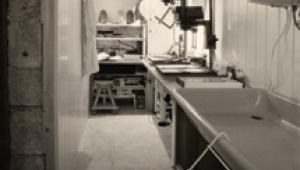
Our
old darkroom: dry side. Even after allowing for the “stretching”
of perspective by the 14mm Sigma lens, you can see that
the dry and wet sides are inconveniently far apart. Again,
taken on Kodak TMZ P3200 by safelight.
|
|
Other Necessities
What about the things that our new darkroom(s) will have in common with
the existing one? Well, we’ll need ventilation, heating, and a washable,
non-slip floor. The window(s) will be blocked with a wooden board, cut
to size, and easily removable for periodical airing out. There will be
plenty of towel racks, and a paper towel dispenser. I’ll use Nova
tanks, safelighting, and print dryer, while Roger will need space for
his Nova processing lines and Jobo CPE-2.
Both the Nova tent and our present darkroom have powerful positive-pressure
ventilation, and this is essential for the new darkroom(s), too: far too
many photographers have hacking “smoker’s” coughs as
a result of poor ventilation. Likewise, we want good heating. Ventilators
keep the darkrooms cool in warm weather, which is welcome, but in cold
weather, heat is important, too. And once you are used to a floor that
can be swabbed down and stays dust-free, it’s very hard (and very
foolish) to go back to cement, even painted cement.
Nova tanks not only save a lot of bench space, but time as well. The chemicals
stay fresh in the tanks for days or weeks, so setup means just removing
the lids, and cleanup is limited to wiping up the odd drip. Nova’s
5 Star LED safelights allow an unreasonably large amount of light, perfectly
safe: they will be wall mounted, bouncing off a white-painted ceiling.
Walls will be white or off-white, except around the enlargers where I
like blackboard paint to absorb any stray light. The Nova flat-bed print
dryer is quick and easy for RC paper.
Roger uses Nova hand lines and a Jobo CPE-2 for film processing, and he
wants both these in a sink, on duckboards, so they can be filled and emptied
quickly and easily; he has already modified the CPE-2 with a drain to
allow fast, easy draining. Opposite this he will need a small dry area
for film handling.
Although we can combine our requirements, if we find the right sort of
place, we’ll probably try to build two darkrooms, one for him and
one for me. Not only will they be optimized for different applications:
they will also mean that he doesn’t have to chase me out of the
darkroom when he needs to process film or to make P.O.P. prints, or even
load a darkslide.
Then again, loading might account for the third darkroom that I mentioned
at the beginning of the article. For film loading, after all, you need
no water, no safelights, nothing except a dust-free (and not very big)
dry area. In the first studio where Roger was an assistant in the 1970s,
this was combined with the “toy box,” a secure cupboard for
storing valuable equipment. So, three darkrooms.
Until we move, we won’t know exactly what we can build. But as long
as we have a good idea of what we need, we shall—we hope—be
able to build the perfect darkroom(s) when we do.
What’s Wrong With
The Old One?
Too much empty floor space.
Sink too small!
Not enough faucets.
Cupboard doors inconvenient.
Chemicals storage wrong/hard to see/hard to clean.
Dry storage space is wrong.
Not enough dry work space.
Retouching/handcoloring best done elsewhere.
Requirements for Roger are different from mine.
Ideas For The New One(s)
A proper darkroom sink.
More taps.
Open storage for chemicals.
Shelves under sink slatted for easy drying.
Open shelves for most storage.
Small dust-proof cupboard for lenses, etc.
Lots of shelves on dry side for paper.
One shelf made of fiberglass screen for drying FB prints.
Wall-mounted enlargers and timers.
Special shelf for RC print dryer.
Wet and dry areas not more than 3-4 ft apart.
Soft rubber mats in front of enlargers to cut down fatigue.
His and hers darkrooms.
Manufacturers/Distributors
Focal Point Industries, Inc. (TexaSink)
(407) 322-2123
www.fpointinc.com
Freestyle Photographic Supplies
(Meopta)
(800) 292-6137
(323) 660-3460 (International & Southern California)
fax: (800) 616-3686
www.freestylephoto.biz
Jobo Fototechnic Inc. (Nova)
(734) 677-6989
fax: (734) 677-6963
www.jobo-usa.com
TruTrak Imaging (DeVere)
(410) 943-1100
fax: (410) 943-1200
www.trutrak.com
|
 |
|
 |
|
|
 |
 |
 |
|