Site Links
|
 |
 |
 |
The Darkroom Care And Feeding Of Enlargers Part I
By Frances E. Schultz July, 2002
| |
Photos
© 2001, Frances E. Schultz, All Rights Reserved
|
|
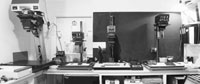
Most enlargers look much the
same: a tall column, with the lamp and negative holder at the top, and
a baseboard at the bottom. But given that a cheap, used enlarger with
a good lens will, unless badly out of alignment, outperform a brand-new,
state of the art enlarger with a bad lens, why do some enlargers enjoy
near-legendary status, while others are scorned and despised?
Partly, build quality. A well made and well maintained enlarger will last
almost forever, and be easy to use throughout its life. But different
kinds of light sources require different maintenance and different kinds
of negatives. Get the maintenance and the negative right, and you can
produce excellent prints: fail to maintain the enlarger, or mismatch the
light source and the negatives, and you will find it hard to get good
prints at all.
|
| |
 |
|
|
Light Sources
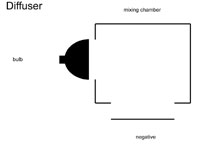
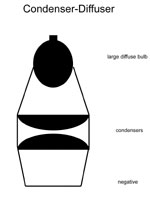
Most modern enlargers are the diffuser type: the light is bounced around
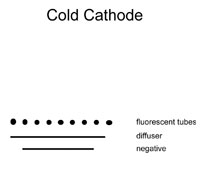
in a mixing chamber (basically, a white box) for diffuse light. “Cold
cathode” enlargers use fancy fluorescent tubes behind a diffuser
screen for a still more diffuse light, while “condenser diffuser”
types use a big, diffuse light source above (or behind) a condenser for
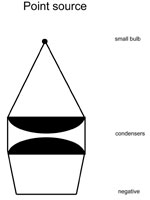
a rather more directional light. “Pure” condenser enlargers
with a point light source provide the most directional light of all. The
four drawings make the different kinds of light sources clear.
Different light sources give different contrasts, even from the same negative
on the same paper. The cold cathode will be least contrasty; the diffuser,
a little harder (typically less than half a grade); the condenser diffuser,
harder again (a grade or so harder than the cold cathode); and the point
source condenser, hardest of all (maybe two grades harder than the cold
cathode).
The exact figures depend very much on the design of the head, but if the
condenser diffuser gives a perfect print on Grade 2 paper, the cold cathode
may require Grade 3 (or more) and the point source Grade 1 (or less).
If you want to use Grade 2 paper for the majority of your prints—which
is a good aim point—then you need to develop your negatives to suit
the light source. If you gain or lose contrast at one stage (the light
source), you have to make it up at another (the negative or the paper).
Getting Level
Caring for an enlarger is hardly onerous. Once it has been set up properly,
it is just a matter of keeping it dry and dust free. Setup consists of
two things: leveling/ parallelism, and making sure the illumination is
even. Both the light source and the baseboard should be parallel to one
another and (preferably) dead level. Leveling is actually less important:
it just makes checking parallelism easier. Lack of parallelism means that
your prints will not be sharp all over because one side of the paper is
further from the lens than the other.
Some top of the line enlargers have bubble levels built-in, along with
leveling feet. If yours doesn’t, keep a small bubble level in your
darkroom to check alignment every now and then. If the baseboard is level,
but the head is out of alignment, look for an adjustment screw somewhere
near the arm which attaches it to the column. Provision of adjustments
for parallelism is one of the big advantages of a top-flight enlarger.
If the baseboard is not level, pack it out with something which will not
slide or shift, or place it on a more level surface.
|
| |
|
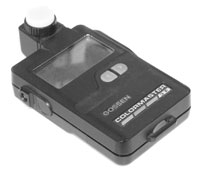
The white spot is the sensor; note how, when metering the
corners, the meter should always be oriented the same way
radially. Failure to do this may result in anomalous readings.
|
|
Even Light
Next, check for evenness of illumination. This can be affected by a number
of different factors including bulb position, condenser setting, condenser
cleanliness, mixing chamber condition, the wrong condenser or mixing chamber,
or something as simple as an under-lens filter holder swung part way under
the lens.
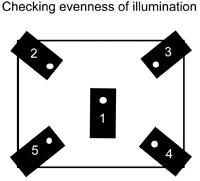
To measure evenness of illumination on the baseboard, use a light meter
with a flat receptor. Take the head part way up the column, high enough
to make it easy to use the meter. Read the illumination in the center,
then at each edge and at each corner. The drawing makes this clear: obviously
you can read in any order.
Try to make sure that the points
you read are the same relative distance from the lens. There will be some
falloff. The extreme corners may be 1/3 to 1/2 stop darker than the very
center, directly under the lens. This is normal. But all corners should
read the same. If they don’t you will need to make some adjustments.
|
|
Check the simplest things
first. Make sure nothing is between the lens and the baseboard. With condenser
diffuser enlargers, make sure the bulb is centered and at the right height.
Make sure condensers are spotlessly clean. The mixing chamber in a diffuser
enlarger needs to be clean as well. When the illumination from my Meopta
Meograde head became uneven, a new mixing chamber solved the problem.
The Styrofoam material becomes gray and dirty after a few years, especially
if the enlarger sees heavy use.
A condenser or mixing chamber which is meant to cover 35mm format (generally
a 50mm lens) will not cover medium format (an 80-105mm lens). You can
use a medium format condenser or mixing chamber with 35mm, but exposures
may be longer.
Check the condition of your lens. Make sure that it is scrupulously clean.
When buying used enlarger lenses make sure they are clean with no scratches
and fungus.
Get Sharp
To get the sharpest prints, test your lens at all apertures. Print a negative
with lots of detail all the way to the edges. The widest aperture will
rarely if ever give you sharpness all the way out to the edges. Stop down
until you find the first aperture which is sharp all over. Then check
the smaller apertures. Diffraction limitation means that if you stop down
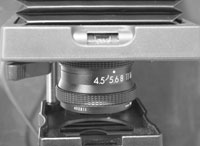
too far, sharpness begins to fall off again. My Meopta 50mm f/2.8 lens
performs best at f/5.6 and f/8. If my exposure times become inconveniently
short, I will use a neutral density filter rather than stopping down more.
Once you have your enlarger(s)—and they do breed in dark places—set
up properly, the only thing you need to do is keep it/them clean and dust
free. Kaiser enlargers come with their own plastic covers. A black trash
bag (slit up one side if need be) makes a serviceable cover. Cover lenses
when they aren’t being used, and store them in bubble cases. In
a humid darkroom, a packet of silica gel in the bubble case will help
prevent fungus.
Keep the whole darkroom clean. When you sweep or run a vacuum cleaner,
let the dust settle before you start printing again. Wipe down surfaces
with a very slightly damp cloth. In my next darkroom article, I’ll
talk about matching negatives to light sources. Until then…Happy
printing!
|
|
nterchangeable Heads
Some enlargers accept interchangeable heads; others have fixed heads.
A few even accept third-party heads, usually cold cathode, color diffuser,
or variable contrast. Most independent heads are first quality but they
are not cheap. Before you consider replacing an old enlarger, find out
what is available in the way of upgrades. The Charles Beseler Company,
for example has special kits available for upgrading some models.
Cold Cathode Mystique
Cold cathode enlargers have a certain mystique attached to them, and are
said to give the closest results to a contact print. I used a cold cathode
before I realized they were supposed to be anything remarkable, and I
can’t say I found it particularly magical. Often, too, they don’t
work too well with variable contrast papers because the light from many
cold cathode sources is disproportionately rich in blue light. There are
however a few special variable contrast cold cathode heads that have separately
controllable blue-rich and green-rich tubes.
Use The Best Lens You
Can Afford
The quality of the enlarger lens you use has much more affect on your
prints than the enlarger itself. In general, a modern multi-coated lens
has more internal contrast than an old lens.
Internal contrast as well as sharpness is influenced by the number of
elements in the lens. With enlarger lenses you generally have a choice
of three, four, or six glass lenses. A three or four glass lens will often
be adequate for enlargements up to about 4x to 6x, but if you want to
enlarge 10x or 15x, a six glass lens will normally give better sharpness.
|
 |
|
 |
|
|
 |
 |
 |
|