


- REVIEWS
Camera Reviews 
More Reviews Mobile Reviews Photography Reviews - GALLERIES
- VIDEOS
- BUYER'S GUIDES

Passport
More Is More
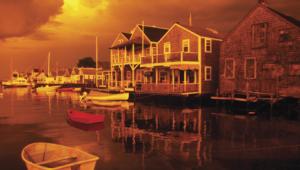
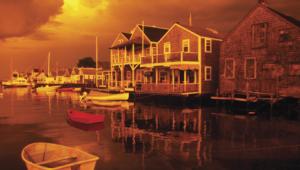
I call it "total coverage"-bringing back the photos that tell the story of a place, an event, a personality. The concept comes from the days, over 15 years ago, when I shot film and video and worked through what was practically a check list of shots that would be needed to tell the story: the establishing (or long) shot, the medium shot, the close-up; and a few shots in-between, like the medium close-up and the extreme close-up. Sometimes I think that the idea of total coverage is the difference between an amateur and a professional. An amateur often goes into a situation or a locale at a frenetic pace, feeling that "no matter what, I've got to get the shot." He sees the shot, takes one or two frames and is out. And truly, amateurs can do that-they aren't shooting for a livelihood-and, in fairness, they often have only enough time to do that. A professional can't take that chance. A pro does just the opposite: he has a purposeful flow to his shoot; he goes in without hurry, uses patience, gets the overall shot, the medium shot, and so on. He stays around to get whatever a scene or a setup has to offer. |
|||
I guess you could say I've made a career of total coverage, and I think it's probably one of the reasons I've been successful. First, of course, I have to produce salable photographs-that's a given-but then I have to have a variety of takes on a particular place or subject. I see the effect of total coverage in my stock sales, as people often call and say that they like a shot I did of, say, the Eiffel Tower, but then they ask if I have it from a different angle or distance, or with a different filter or different lens. And as a matter of fact, I do-I have a lot on my subject. "Let me send some other views to you," I say. And there's a sale. The benefit of total coverage for an amateur photographer is not in sales, but in better pictures-if you truly work a scene, chances are you're going to first add variety to your images, and then, because you're going to start looking for different ways to portray your subject, you're going to add imagination. |
|||
Before I sat down to write this column, I'd never really thought about total coverage in terms of it being a shooting plan, but now as I think about how I go about my shooting, it does seem pretty systematic. The photos you see accompanying this article are typical of how I work. They're from a two-hour session I did with a Chinese opera performer. I started with the long, establishing shot, using either my 80-200mm zoom or my 300mm telephoto; then I gradually moved in closer, getting a more intimate portrait, until I was in close with my favorite lens, the 50mm f/1.4. Then I worked different angles, backgrounds, props €and then thought, now that I've covered this in color, how would it look in black and white? If I shoot in black and white, will there be a different feeling and meaning to the pictures, which can mean another market for the images? Lastly, I always think about how I'm interpreting the subject. I'll start with something basic, the expected view of the scene, then move to something more unusual, maybe even weird. |
|||
But you can't do any of these things unless you exercise patience and discipline and stay in a scene long enough to push the envelope, to challenge your brain to look at a subject differently, no matter what that subject is-a landscape, landmark, or person. You have to keep yourself open to what the scene is saying to you. It's more than just "spending the time"-though that's important, and often professionals have more time to spend on a location because that's their job. It's really about using the time wisely, applying ideas to the time and then exploring those ideas. Of course, here we're talking about what I do-travel photography, and these ideas we've been talking about benefit travel images in another way. By spending the time and challenging yourself, you're going to learn about a place you might never before have visited. You're learning the territory, and that means you won't be overwhelmed by it. |
|||
I'd suggest even going to a location and just sitting there, watching what's going on. Don't shoot; observe. If it's a well-known landmark-let's use the Eiffel Tower again-just walk around, then sit down, observe, see how other people react to it. Look, too, at how other photographers shoot it. Relax, maybe take a few notes on the light. Don't rush through the experience. Take the time to allow the subject to come to you, rather than rush up to it, shoot and run off. Sometimes conditions require that you take your time. For the photos here, which were taken in Singapore, I paid the model for the session, hired an interpreter and transportation and picked a particular location for the shoot. And when we got there it was pouring rain. So I went to Plan B-find protection from the elements. I located an awning, which meant I had to go to a higher speed film and think a little differently about my subject, as opposed to just shooting in bright sunlight or open shade. For a while we tried waiting out the rain and during that time I talked with the model. For 20 minutes I asked about the makeup and costumes; we talked about Chinese opera and its roots. By the time I started shooting I had a much better sense of what I was doing and wanted to do, and I know that 20 minutes made a big difference in the quality of the pictures. |


| ||
|
||





 FEATURED VIDEO


Get the Latest Photo Tips, News & Reviews from Shutterbug!







| Camera Reviews Other Reviews | |
Mobile Reviews Photography Reviews Columns | |
News | |
Features | |
How-To | |
Resources |
 © 2026 Shutterbug
AVTech Media Americas Inc., USA
All rights reserved