


- REVIEWS
Camera Reviews 
More Reviews Mobile Reviews Photography Reviews - GALLERIES
- VIDEOS
- BUYER'S GUIDES

Bill Sallaz; Keep It Real
"As they go through their routines, I see the shot. I want to see the moment so I'll know it's coming."
You'd think it would be Rule Number One: when the stock shot is a sports
image, you get players, not models. Always shoot the folks who know how to play
the game. But you'd be surprised how many times we've talked to
sports photographers who laugh at sports-themed shots because someone wasn't
paying attention or didn't know better. The sports shooters' comments
have included "No runner would wear that kind of watch," and "The
grip on the pole is wrong."
Bill Sallaz has photographed both the real thing and the setups. He says, "On
stock shoots, agencies know they have to provide people who have real talent
at the sport--good high school players or ex-college players who have stayed
in shape or who are still playing. And I want to see them first. Before we commit
to a dawn shoot someplace 30 miles away, I need to see 'em."
On a commercial shoot, often the client will want to provide the talent. "That
means pretty people from modeling agencies," Bill says, "or, worse,
someone from their own company who fancies himself a great tennis player or
great golfer, who usually turns out to be somewhat less than great and not at
all convincing."
 |
|
|
Once he's on location with the athletes, Bill's first move is
to establish the motion they're going to be doing. "I explain to
people what I want, and I block in the space, changing my camera angle according
to what they're going to do. I set it up, tell them what I want and how
I imagine the shot. Then I ask them, `Now, is there anything I'm
asking you to do that's wrong? Any moves you wouldn't make?'
As they go through their routines, I see the shot. I want to see the moment
so I'll know it's coming.
"Then I bring up the energy level. I explain that I don't want them
going through it at half speed or holding a pose. I tell them that I'm
a pro, and I'm quick and I'm not going to miss it. And if I do miss
it, I'll ask them to do it again. Then I ask them to do it at full speed."
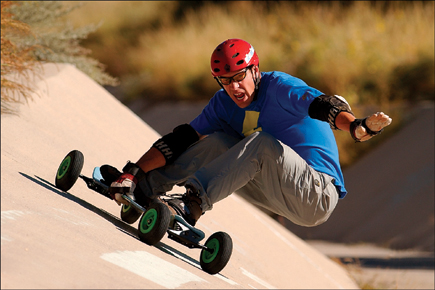
And sometimes at full volume. "I tell them to be loud. If I have a tennis
player or a football player yell when they're doing the moves, it breaks
their natural tension. They'll almost always just be doing whatever they're
doing at only 80 percent, no matter what I tell them about going full out, but
if I can get them to yell, I can bring up the energy. And I get loud. I yell,
`Cmon, let's go, let's see it full speed!'"
 |
Experience tells him he'll get five or six full-speed run-throughs.
"I won't get 20 frames at that level. Once they've peaked,
it drops off. So it's important to make the subtle changes on my lighting
and position before I encourage them to full speed. I'll get three or
four frames that'll look really good at their top level, then their energy
drops off the other side." That factor is even more apparent with younger
athletes. "With kids you have a limited attention span. It'll be
fun for only a couple of shots, so be ready."
Bill Sallaz is a NikonNet "Legends Behind the Lens" featured photographer.
The current "Legends" story and an archive of profiled photographers,
including Bill, can be found at www.nikonnet.com.
Bill's website is www.sallaz.com.
| ||
|
||








 FEATURED VIDEO


Get the Latest Photo Tips, News & Reviews from Shutterbug!







| Camera Reviews Other Reviews | |
Mobile Reviews Photography Reviews Columns | |
News | |
Features | |
How-To | |
Resources |
 © 2026 Shutterbug
AVTech Media Americas Inc., USA
All rights reserved