


- REVIEWS
Camera Reviews 
More Reviews Mobile Reviews Photography Reviews - GALLERIES
- VIDEOS
- BUYER'S GUIDES

Lesson Of The Month
Using Light Reflections For Outside Portraiture
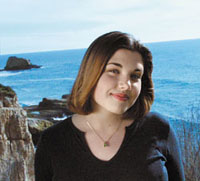
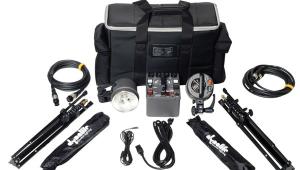
Photographing people outdoors can present a number of challenges, particularly on a bright sunny day. Because film (or a CCD) from a camera cannot compensate for contrast as well as the human eye, it is often imperative to modify the light from the sun to achieve better, more professional looking results. This lesson will illustrate two basic approaches to shooting portraits outside with light modification. In the first example, my friend Jessica and I went out to a nearby cliff overlooking the ocean in the early afternoon. Since the sun was coming from the direction of the water, and I wanted to use the cliffs as a background, I had Jessica turn slightly away from the sun so that the majority of her face was in shadow. I took a meter reading to expose the background properly, set the camera to f/22 at 1/125, and took my first shot (Figure 1). Notice that everything except Jessica's face has good exposure. I placed the meter (directed toward the camera) on the shadow side of her face, and got a reading of f/11 at 1/125. If I opened up two stops to match the reading, then the background would be too bright and lose tonal density and color saturation. Since I wanted to maintain this exposure level, I decided to bounce light from the sun on her face, thus reducing the contrast. As there was a bit of a breeze blowing, I set up a heavy-duty light stand to the left of Jessica and secured a sandbag to it for stability. Next, I clipped a soft gold reflective light disc on a light disc holder and affixed it to the stand. I positioned the disc so that the reflection was present, but not overpowering. I have found that it is usually best to use reflectors subtly, as it is easy to go overboard and create artificial looking images (Figure 2). |
||||
I took another reading in the shadow side of her face and got f/22.2. Without adjusting my f/stop, I took another shot. Notice how Jessica's face is now well within the same exposure range of the rest of the composition. The reflector has also produced a nice catchlight in her eyes (Figure 3). In the second example, my wife
Heather and I drove to a nearby park with beautiful eucalyptus trees.
As we looked for a backdrop, we noticed an area where the light raked
across the trees and decided that would be the spot. The light fell across her face
the same way it did the trees, and again the result was too high in contrast.
I metered on the shadow side of her face and got f/8.8 at 1/125. I had
a couple of options: I could position a reflector to the left of Heather
and bounce sunlight on the left side of her face, or I could use the same
setup while diffusing the direct sun from the right side. I chose the
latter to allow the light to be softer in her face. |
||||
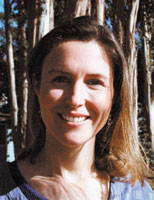
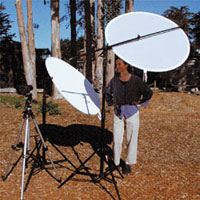
I set up two sandbagged light stands on either side of her and affixed two light disc holders to them. To the one on the right I attached a translucent disc and positioned it between Heather and the sun. To the left one I attached a white reflector and positioned it to bounce direct sunlight on the left side of Heather's face (Figure 5). I took another meter reading
from the center of her face and got f/16.3. I opened up a 1/4 of a stop
and took another shot. Notice now that her face is evenly lit, and again
there is a nice catchlight in her eyes (Figure 6). This lesson will be posted in the free public section of the Web Photo School at: www. webphotoschool.com. You will be able to enlarge the photos from thumbnails. If you would like to continue your digital step by step education lessons on editing, printing, and e-mailing your photos it will be on the private section of the Web Photo School. Shutterbug has negotiated with WPS to offer our readers a special 33 percent discount rate of $30 per year. To enroll at this discount just go to: http://shutterbug.webphotoschool.com and fill out the Shutterbug questionnaire which will help us to publish lessons for you in the future. Technical Equipment Cameras: Olympus C-2500L
digital camera; Olympus USB SmartMedia Reader-Writer; Hasselblad (as a
stand-in for setup shots) |



| ||
|
||







 FEATURED VIDEO


Get the Latest Photo Tips, News & Reviews from Shutterbug!







| Camera Reviews Other Reviews | |
Mobile Reviews Photography Reviews Columns | |
News | |
Features | |
How-To | |
Resources |
 © 2026 Shutterbug
AVTech Media Americas Inc., USA
All rights reserved