


- REVIEWS
Camera Reviews 
More Reviews Mobile Reviews Photography Reviews - GALLERIES
- VIDEOS
- BUYER'S GUIDES

Dynamic Range
Dynamic Range
by George Schaub
Dynamic range is the ability of the sensor to capture a certain range of light and dark, or brightness values. Think of it as the number of keys on the piano the “hand” of the sensor can cover. While the sensor may offer an octave’s worth of tones, this octave can be moved all around the keyboard. If the light is low the sensor can adjust through the use of high ISO and slower shutter speeds and wider apertures. If that range of notes is bright then the sensor can be adjusted to handle exposure with narrower apertures, faster shutter speeds and lower ISO settings. Though there is a wide range of adjustment the sensor and settings can be made to handle there is always a certain range of light that it can record—that’s the dynamic range of the sensor. An important part of mastering exposure is understanding this and seeing light, and especially contrast, the way the sensor sees it.
 |
|
|
When making exposures try to exploit and record the full range of brightness values in the scene. This will give you more creative leeway later when you make prints or work on the image in software. The exposure of this fall scene gets into every nook and cranny of detail, even in the dark recesses of the bark. But there are some areas it cannot properly exposure, such as the dark shadows. But these shadows help define form as do some of the brighter highlights.
 |
 |
There is a software technique for combining exposures to get the most from a scene with high contrast values. This involves bracketing exposures, and it is something we will cover in detail in our Tips section. As a preview, here are two shots that have been over and underexposed, and then combined later for the final fuller range image. For most of your shots, however, that extent of exposure work is usually not practical, or even worth the trouble.
Our eyes adapt to changes in brightness because our pupils are constantly opening and closing as we look around, and the signals to our brain are integrated as we look from, say, the deep hollows of a canyon to the bright horizon. The “eye” of the camera, the pupil in the lens, is fixed at 1 EV, so
when we make a picture it is as if we have locked onto a specific brightness, and all other values have to follow suit.
 |
So if we are making a picture of a deep canyon with bright snow surrounding it, making an exposure only for the deep canyon (the shadows) will result in the bright, snowy field recording too brightly, or becoming highly overexposed. In fact, it will be so bright that it will be “burned up” or lose detail. If we lock the opening in our eye (or camera lens) on the brightness of the snowy field we certainly won’t see any details in the dark canyon.
Dynamic range defines just how bright that snowy field can be and how dark the shadows in the canyon can be and still get details in each area when you make a careful exposure reading. It is the limitation of the recording material, and is an important aspect of making good exposure decisions. As you gain experience one of the most important matters to concentrate on is developing a sense of this range and understanding what your camera can and cannot do. In short, learn how it handles different light values (contrast) within the same scene.
 |
 |
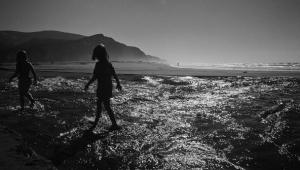
The ability of the sensor to capture a range of brightness values will determine when you will be able to capture all the values in the scene (or at least all the important values) and when you might have to give up shadow detail in order to control the highlight areas. This shot was made late in the day in New York City with a bright sky and the buildings in shadow. The high contrast is part of the character of the shot, and the limits of dynamic range are exploited for a graphic interpretation of the scene.
Sometimes you have to make a choice between high and low ranges, sometimes referred to as high-key and low-key effects. You make that decision by choosing an exposure range, or making an exposure that saturates the highlights (thus sacrifices shadow detail) or opens up the shadows, which might overexpose some highlights.
 |
 |
This bracketed shot shows both high- and low-key effects.
The dynamic range of digital cameras will vary according to the camera and its sensor, but it is not especially broad. It can also be affected by how you program the camera when you shoot, and by what format (JPEG or raw) you choose. There are, however, ways that you can jump this hurdle and make a series of images of the same scene that allow you to break the dynamic range rules, something we will cover in the Tips section.
Tied in with dynamic range is something called exposure latitude. This is the ability of the recording material to deliver useable images when they are over or underexposed. The best quality of course comes from making a good exposure every time. But in general, if there is a mistake you’ll find that if you underexpose by a stop or a bit more you will have no problem salvaging the image in processing. Overexposure, however, or having too much light hit the sensor can create problems that are hard to fix as easily; if you overexposure badly the image is usually irretrievable.
 |
While excessive underexposure will render an image useless, due to the amount of noise generated during correction, slight underexposure is no problem. This photo is about 1.5 stops underexposed, but some easy software work brings back a nice range of values. While still dark overall it has enhanced color and contrast.
Overexposure is problematic, as once the pixels are too “hot” it is very difficult to correct them with anything but a darker tone, with no detail. This overexposed shot resulted from reading the background and not the bright light off this tree. While the image can be worked on to bring out a better tonal value it will not be as effective as one that was correctly exposed.
To repeat, your biggest enemy is excessive overexposure. So, exposure latitude on the highlight (bright or overexposure) side is fairly narrow. If you have photographed with negative film in the past this is counter-intuitive, but is an important fact to keep in mind when shooting digital. We’ll discover how to diagnose for overexposure as you shoot later.
| ||
|
||







 FEATURED VIDEO


Get the Latest Photo Tips, News & Reviews from Shutterbug!







| Camera Reviews Other Reviews | |
Mobile Reviews Photography Reviews Columns | |
News | |
Features | |
How-To | |
Resources |
 © 2026 Shutterbug
AVTech Media Americas Inc., USA
All rights reserved