


- REVIEWS
Camera Reviews 
More Reviews Mobile Reviews Photography Reviews - GALLERIES
- VIDEOS
- BUYER'S GUIDES
Digital Storage Solutions On The Road; Options Galore For The Traveling Photographer
How can you make the most use out of that limited quantity of memory cards when on the road, especially on a long trip? The answer: a portable drive. When connected to a host computer via USB 2.0, all these devices are recognized as an external drive--but not immediately in some cases: it may require activation of a USB function on the device. Adding to the utility of many of these portable devices is a built-in card reader/writer that is immediately recognized as such by the computer as well. These drives seem to work equally well under the latest versions of Windows XP and Mac OS 10.4 (but confirm compatibility with older operating systems before buying the unit).
 |
|
|
Most of the devices we've selected also offer additional benefits, among
them a large screen display--over 3.5" diagonally, which lets you
view downloaded pictures individually or as slide shows, and the device will
even display a histogram and exposure data. Several of these devices let you
view video clips, listen to music (functioning practically on par with a dedicated
MP3 player), and even record audio (via the built-in mic or through a line-in
connection to an external sound source or from a built-in FM radio). And stereo
earbuds and a remote may even be supplied.
Of course, not every device offers these bells and whistles, nor is that a primary
concern here--but convenience features are nice during a lull in your shooting
schedule. More importantly, among primary functions centered on the images,
not all devices provide the same quality or degree of utility.
 |
|
|
Each of these devices runs on a rechargeable battery. If we drain the battery
looking at videos, listening to MP3s, or even constantly being awed by our own
photographic talents in slide shows, there won't be any power left when
it comes time to download images from memory cards. Not to mention, these devices
are a lot bulkier and heftier than the everyday lightweight, slim-line MP3 player.
But to play it safe, keep the auto-switching (dual-voltage) power adapter/charger
handy (and plug adapters, where necessary). On the other hand, consider carrying
a spare battery--a good option if you'll be on the road for more
than a few days and away from a source of electrical power for charging. Or,
with select portable drives, you can charge the device (when switched off) directly
from the USB port on your laptop.
Other Key Features
Each of the devices we're looking at carries a rugged 2.5" hard
drive similar to the one housed inside that laptop that travels everywhere with
you. Storage capacity can range from 40GB to an amazing 160GB. I've worked
extensively with one device that sports an 80GB drive. I've taken it on
two trips, let it bounce around a bit in the unpadded section of a camera backpack
(inside its pouch), and it was no worse for wear. Provided you don't throw
it against a concrete wall or use it for batting practice, any of these devices
should hold up for some time. And just for added insurance against modest bumps
and grinds, each portable drive does come with its own pouch, or, in one instance,
inside a hard, rubberized casing.
 |
|
|
Putting Five Devices To The Test
Here is how we judged each device and some of our results:
· Ease of use. How easy was it to navigate the screens
and use the buttons to activate the various functions? Was the interface intuitive?
You don't need to be a rocket scientist to run these devices, but one
device in particular--the Sanho--lost points here.
· Memory card support. Does the device support the memory
card you primarily use? The card most widely supported is CompactFlash (and
Microdrive); SmartMedia is not supported on these devices (but may be supported
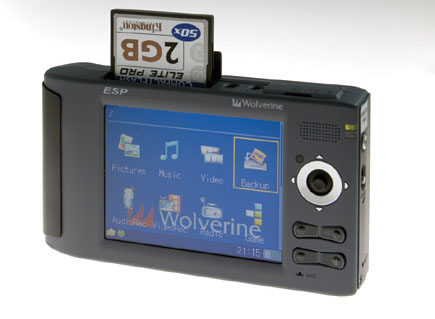
on others). The Wolverine and Digital Foci provided the widest card support
among viewers, with the Sanho supporting the most cards in any category.
· Card reader/writer. Does the device do double duty
as a card reader/writer when connected to a host computer via USB 2.0? All these
devices read from and write to the memory card. But the question remains, is
the card recognized by the connected computer just as it would be had you been
using a stand-alone card reader? Only the Epson, Wolverine, and Digital Foci
can make this claim, making them the most utilitarian devices among those reviewed.
· Raw file support. Does the applicable device support
raw files for your camera? The good news is that firmware is constantly being
updated and all it takes is a simple download off the web. But verify support
before buying the device. All viewers that were reviewed here support raw files.
| |||||||||
|

| ||||||||


 FEATURED VIDEO


Get the Latest Photo Tips, News & Reviews from Shutterbug!







| Camera Reviews Other Reviews | |
Mobile Reviews Photography Reviews Columns | |
News | |
Features | |
How-To | |
Resources |
 © 2026 Shutterbug
AVTech Media Americas Inc., USA
All rights reserved