


- REVIEWS
Camera Reviews 
More Reviews Mobile Reviews Photography Reviews - GALLERIES
- VIDEOS
- BUYER'S GUIDES

Fujichrome Provia 400F Pro Plus Sensia 200 And 400 Films
Over the past two years, we have seen significant improvements in all ISO 400 and 800 color print films, but few advances in the "fast" color reversal products. This is understandable because color neg film outsells slide film by a vast margin, even among professional photographers. Consequently, most have considered ISO 200 as the fastest color slide film that still produced exceptional image quality: in terms of sharpness, grain, and color saturation. When much faster shutter speeds were required, photographers generally "pushed" ISO 100 or 200 slide films to an Exposure Index (EI) of 400. This worked well with the pro films optimized for such extended processing, but added to the cost because most labs charge extra for such services. With the introduction of Fujichrome Provia 400F Professional (designated RHP III) the situation may start to change. A new generation film which boasts extremely fine grain, said to be "the best among films of its speed class," it also produces nice, bright colors and moderate contrast for the speed. With an RMS granularity value of 13, Provia 400F offers much finer grain than its predecessor, the original Provia 400 with a rating of 15, indicating more noticeable graininess. In fact, the new film is competitive with some ISO 200 slide films--including new Sensia 200--in terms of granularity value. The resolution numbers are also impressive. With a low contrast target, Provia 400F can resolve 55 lines/mm; with a high contrast target, 135 lines/mm. |
||||
In order to fully evaluate all of the characteristics of Provia 400F I shot a dozen rolls in the 35mm format under various lighting conditions. Because I was also testing other films for a report to be published later, I shot several specific scenes with a variety of films, and this provided a useful comparison. My subjects included the bold primary colors of the New York, New York casino in Las Vegas, pastel-colored buildings in Miami, the gorgeous red rock formations in Zion National Park and Valley of Fire State Park, plus low-light situations handheld: the interior of a cathedral in Washington, DC, and neon signs against a black sky at night. After examining all of the Provia 400F slides under an 8x loupe on a light box, I made the following assessments:
|
||||
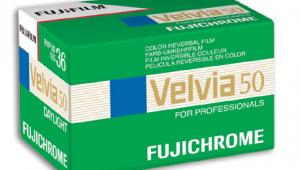
Color Balance And Rendition In terms of color saturation, the difference between the old and new Provia 400 films is minimal in this regard, at least to my eyes; both offer color saturation that's high for an ISO 400 film. Naturally, the ISO 100 films produce more vibrant colors while those of Velvia are far more saturated. Although Velvia colors are certainly dramatic, the subtlety of Provia 400F produces a pleasing but understated effect, with memory colors: hues and tones that are closer to our recollection of the subject. Because saturation is not excessive, the slides show subtle details such as textures and veins in the richest red rock formations. A 1/3 stop of underexposure boosts saturation and can be useful when a bold, graphic effect is desired. Overexposure of up to 1/2 stop still produces acceptable slides, but results in colors that are rather pale. As to color rendition, yellows, pinks, and pastels are light, "clean," and accurate. Reds are rendered as bright, bold, rich, and pleasing; excellent overall. Greens seem very neutral, without the "exaggerated" effect produced by Velvia but not particularly striking. I found blues and purples gorgeous: rich and fully saturated, very striking. Sky tones are exceptional and particularly deep when polarized. Thanks to a good D-max, blacks are rich and dark, and this factor changes little when the film is pushed one stop. Finally, I found that whites and grays are close to perfect, without any apparent color cast. |
||||
"Push" Characteristics But how does Provia 400F compare to Provia 100F when that slow film is pushed two stops to an EI 400? Frankly, the results are similar in terms of graininess. As expected, Provia 100F still produced sharper slides with higher resolution of fine detail. However, the contrast of Provia 400F at ISO 400 is less harsh, an advantage in situations including important detail in both highlight and shadow areas. |
||||
Conclusion I would still use an ISO 100 slide film when the extra speed is not essential, but Provia 400F was a blessing when shooting interiors where flash and a tripod were not practical or prohibited. This film would also be useful in some action and fashion photography as well as in photojournalism. Whenever high shutter speeds are essential to get the image, the new film would be a suitable choice, and would save the cost of push processing. When even higher shutter speeds are required, I would not hesitate to push this film one stop, although I would think twice about more extensive pushing unless there was no other way to get the required shots. |
||||
No one is suggesting that even an excellent ISO 400 slide film should be the standard choice for serious photographers who want the highest sharpness, resolution, or color saturation. Consider Provia 400F (or Sensia 200 or 400) as a problem-solving tool and carry some rolls in your camera bag as I have been doing. When a situation calls for a fast film, shoot it with confidence, knowing that it offers surprisingly fine grain, contrast that's not excessively harsh, and satisfying color rendition. Viewed in this light, the new film may become indispensable, and may save on push processing unless even higher shutter speeds are necessary. Note: It is extremely difficult to reproduce all slide characteristics with absolute fidelity on the printed page. Hence, if the illustrations do not seem to exactly match the captions, rely on the written analysis as the accurate representation of the image characteristics. Fujichrome Provia 400F (RHP
III) Technology |
||||
Fujifilm's tech notes indicate other benefits: "a rich tonal scale for greater highlight and shadow detail, wider exposure latitude than any existing high-speed film" plus increased interlayer effect for "faithful and brilliant color reproduction equal to that of ISO 100 films." Other less radical improvements are also claimed for Provia 400F. Advanced Emulsion Aging Stability Technology is said to improve long-term storage characteristics of unexposed film with minimal changes in color balance and sensitivity. The Advanced Development Inhibitor Releaser Technology has been further enhanced through newly developed DIR compounds. These offer improved edge and interlayer effects that make for "superb resolution and color reproduction." As well, a yellow filter dye is used for superior development of the blue-sensitive layer for greater stability in push processing. The result is said to be "superb color reproduction and more consistent color balance even during extended push processing." Indeed, Provia 400F is recommended for "pushing" to a full three stops (for an effective film speed of 3200) "with minimal variation in color balance or gradation." (The new Sensia films are not recommended for push processing.) For the previous Provia 400, only a one-stop push processing was recommended. As a bonus, the new film is said to be highly resistant to film speed loss or "reciprocity failure" during very long exposure times. No exposure or filtration compensation is required in exposures up to about 60 sec. New Fujichrome Sensia Films When checking my slides with an 8x loupe, I noted that images made with Sensia 200 are a bit sharper since its resolving power is higher: 60 lines/mm with a low contrast target and 140 lines/mm with a high contrast target. The grain structure appears slightly finer, although its granularity value is also 13--perhaps a low 13 vs. a high 13 for the ISO 400 films. All three films feature superior reciprocity characteristics, too, as mentioned in the Provia 400F technical section. Contrast for all three films appears identical: only moderately high, so detail is visible in both highlight and shadow areas except in extremely contrasty light. When the extra speed is not required, I would use the ISO 200 film because of its minor advantages. |


| ||
|
||









 FEATURED VIDEO


Get the Latest Photo Tips, News & Reviews from Shutterbug!







| Camera Reviews Other Reviews | |
Mobile Reviews Photography Reviews Columns | |
News | |
Features | |
How-To | |
Resources |
 © 2026 Shutterbug
AVTech Media Americas Inc., USA
All rights reserved