


- REVIEWS
Camera Reviews 
More Reviews Mobile Reviews Photography Reviews - GALLERIES
- VIDEOS
- BUYER'S GUIDES

Classic Cameras; The Top 20 Cameras Of All-Time Countdown; Schneider’s List, The Next Five–Do You Agree?
Contributor Jason Schneider is a world-recognized expert on Classic Cameras, so when he approached us with the idea to present a Top 20 Cameras of All-Time list we readily agreed. We began in our April 2008 issue with the first five in the list, and now bring you the next group as we work our way down to the Top Camera of All-Time. Please check our Classic Camera archive on the website, or type in Top 20 in the Search box for the first installment. We have also created a Forum site for discussion on this topic, which we are sure will stir some debate: go to www.shutterbug.com and click on Forums to join in.--Editor
15) Asahiflex IIB--1954
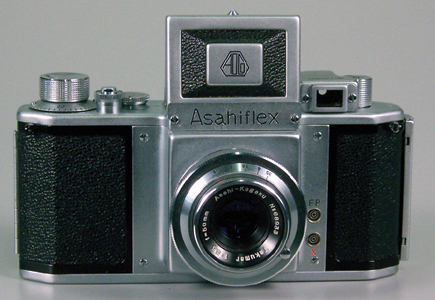 |
This handsome, waist-level-viewing 35mm SLR was the first to combine an instant-return mirror with conventional through-the-lens viewing and focusing, a feature that helped establish Asahi as a major manufacturer and led to the development of the Asahi Pentax line. (The limited distribution, Hungarian-made Gamma Duflex of 1947 had an instant-return mirror, but focusing and viewing were separate operations.) The instant-return mirror, which provides the psychological advantage of nearly continuous viewing, was eventually adopted by every major SLR maker, and was a factor in the vastly expanded popularity of SLRs in the '60s and '70s.
Like all Asahiflexes prior to the Asahi Pentax of '57, the IIB also has a small optical finder for the 50mm lens to the left of the focusing hood, primarily to aid in tracking action, which is difficult with the waist-level finder's laterally reversed viewing image. In other respects, the Asahiflex IIB is a simple, well executed, and straightforward machine featuring a horizontal cloth focal-plane shutter with speeds of 1/25 to 1/500 sec plus B set via a top-mounted rotating dial, hinged back, film wind and rewind knobs, and FP and X flash sync sockets. The threaded lens mount is 36mm in diameter, and there was later a 36-42mm adapter to let you use Asahiflex lenses on the newer Asahi Pentax cameras. The Asahiflex IIB is a fine, competent user collectible that's fairly uncommon in the US, but usually moderately priced when found. A clean, functional example with preset 50mm f/3.5 or 58mm f/2.4 Takumar lens sells for around $300-$350.
14) Sony Mavica--1981
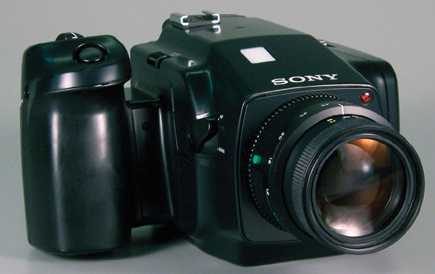 |
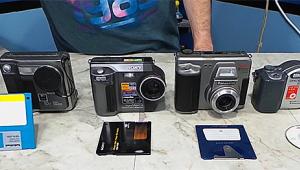
When Sony's president, Akio Morita, announced the first commercial still video camera, the Mavica (Magnetic Video Camera), in August 1981, it generated international interest, but few realized that it marked a major paradigm shift in image capture that was destined to change the face of photography. The original Mavica was not really a digital camera--it was essentially a television camera that recorded TV-quality images on 2" magnetic floppy discs called Mavipaks. Its single-speed 1/60 sec shutter allowed it to freeze frames within the limits set by the twin-field interlace making up the complete frame. The Mavica of '81 was an SLR with interchangeable lenses and was released with three bayonet-mount lenses, a 25mm f/2, a 50mm f/1.4, and a 16-65mm f/1.4 zoom. Resolution of its 10x12mm CCD was only 570x490 pixels, lower than VGA. Sensitivity of the chip was rated at ISO 200, and each image was recorded in its own single circle on the disc, which could store up to 50 color images. The Mavica was powered by three AA cells, and the images were displayed on a monitor or printed out. Image quality was said to equal the maximum capability of TV sets at the time, and did not seem to pose a threat to the supremacy of film.
But the historical and technological significance of the original Sony Mavica lie not in its performance per se, but the fact that it implied a whole new world of imaging possibilities that were to be developed, by Sony and many others, with unflagging dedication and at an amazing pace. To quote from Sony's original announcement, "Sony...has developed a revolutionary video still camera, embodying fully the advantages of electronic technology...CCD and IC semiconductors. The Mavica system...uses no photographic film and therefore does not require developing and printing processes, which are indispensable to conventional chemical photography. This new video still camera represents an epoch-making innovation...and a fundamental change in the concept and technology of photography." For once, the PR guys got it right.
An original Sony Mavica is certainly a collectible that belongs in any well-appointed science museum. Estimated price of a complete outfit: $5000 and up.
13) Contax S--1949
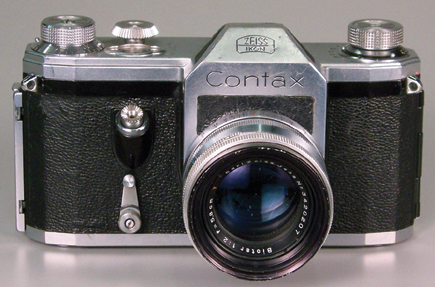 |
The first widely distributed 35mm SLR with an eye-level penta-prism providing laterally correct, right-side-up viewing and focusing, the Contax S, a product of VEB Zeiss Ikon (generally known as East German Zeiss), was also the first to embody the classic modern SLR shape adopted by virtually all other manufacturers. (The Italian Rectaflex and Swiss Alpa Prisma Reflex III, both penta-prism 35mm SLRs introduced in the same year, were of very distinctive design and produced in limited quantities.) The penta-prism used in the Contax was most probably developed by Zeiss in the late 1930s, and its 42mm threaded lens mount appeared simultaneously on Praktica SLRs. The Contax name was changed to Pentacon (a combination of penta-prism and Contax) in '57, and many versions of the camera, often not as well finished, appeared under a variety of names, including Hexacon, Consul, and Corbina. The general configuration of the Contax S, and its M-42 screwmount, had a profound influence on SLR design for well over 20 years. Examples include various Rolleis, Voigtländers, Edixas, and Zeiss Ikon Icarexes from Germany, and Japanese SLRs of the '60s and '70s, including Pentax, Fuji, Yashica, Ricoh, Chinon, Cosina, and the short-lived Olympus FTL.
A straightforward, elegant machine, the Contax S features a cloth focal-plane shutter with speeds from 1 second to 1/1000 sec plus B set via a single, rotating, top-mounted dial with speed read-outs under a small glass window, knob wind and rewind, a 45° angled shutter release, flash sync connection in tripod socket, hinged back, and self-timer. It lacks an instant-return mirror and automatic lens diaphragm actuation--later models feature semiautomatic diaphragm operation via an internal stop-down plate in the body, and the Contax E of '53 was the first SLR with a built-in (selenium) meter. The Contax S is a fine collector's piece, and a competent picture taker if you can put up with its dim (by modern standards) finder and noisy shutter. Models labeled Contax and bearing the Zeiss Ikon logo are not too common and fairly pricey--$400-$500 with preset 58mm f/2 Carl Zeiss Jena Biotar lens, a bit less with 50mm f/2.8 Carl Zeiss Jena Tessar. Later models labeled Pentacon or Hexacon with C.Z. or other lens designations are less desirable and sell in the $150-$250 range.
| |||||||||
|

| ||||||||










 FEATURED VIDEO


Get the Latest Photo Tips, News & Reviews from Shutterbug!







| Camera Reviews Other Reviews | |
Mobile Reviews Photography Reviews Columns | |
News | |
Features | |
How-To | |
Resources |
 © 2026 Shutterbug
AVTech Media Americas Inc., USA
All rights reserved