Site Links
|
 |
 |
 |
The Darkroom Your Traditional Darkroom
By Frances E. Schultz December, 2003
| |
New
York skyline. When I took this shot it was just another
New York skyline. Had I been shooting digitally, I might
have deleted it because it didn’t say anything new.
Now it is one of only a handful of shots that I have of
the World Trade Center. Now it is important.
Photos © 2003, Frances E. Schultz, All Rights Reserved
|
|
What is the use of having
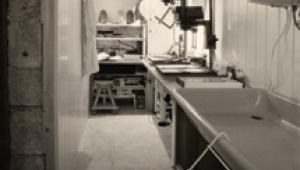
an old-fashioned, “wet” black and white darkroom in the
21st century? Well, it’s a bit like religion. If you have to ask
the question, you’ll never understand the answer. Anyone who loves
darkroom knows the answer. Producing a real, silver halide print the
old-fashioned way is both art and craft. But there’s even more
to it than that.
Why do I call the darkroom an alternative process? Regardless of what
the digital brigade say, silver is still the mainstream, and will be
for many years to come. The reason I call it “alternative”
is simple. “Alternative” processes are done for two reasons:
1) they are beautiful and 2) they are very, very long lived. They rarely
make commercial sense. Traditionally, “alternative” processes
include bromoil, argyrotype (the Van Dyck process), cyanotypes, gum
bichromate, platinum printing, and salt prints. These arcane processes
are usually far more difficult than conventional darkroom work, but
they remain popular because of the “look” they produce,
the satisfaction of mastering the process, and the durability of the
prints.
|
| |
Guard
dog. In color, this is just a snapshot. In black and white,
it is timeless: it becomes symbolic of all guard dogs, all
barns, all elderly trailers.
|
|
Open Up To The Silver
Options
Start treating “mainstream” silver like an alternative process,
however, and you are suddenly liberated. You can use any films, papers,
chemicals you like. All that matters is the end result. You don’t
have to worry about the “mainstream.” You can say, as did
Julia Margaret Cameron, “I focused until it was beautiful.”
Not “until it was sharp,” notice, but “until it was
beautiful.” She died in 1879. Her pictures are still acknowledged
today as among the finest portraits ever made. That’s what you’re
aiming for: immortality.
Don’t be afraid to leave the mainstream when it comes to film and
format. Ilford Delta 3200 for portraits? Why not? Four by five for sports
and action? Sure, if you can do it: some of the finest boxing and motor
racing pictures of all time were taken with big old press cameras. Is
that the way you see?
Don’t be intimidated by people who tell you exactly how to expose
and process your films. Experiment. Make deliberate “mistakes.”
If you get the best results—the ones you like best—by rating
the film at twice (or half) its ISO speed and developing it twice (or
half) as long, that’s fine. It’s your vision. If you want
your negatives to outlive you (and you might not) then make sure they
are archivally processed: one of the great advantages of an alternative
process is durability, but I will come back to this later.
|
| |
Ulysses S. Grant. This picture was probably taken around
1863, 140 years ago, when Grant became a
major-general. This is a modern print, archivally washed
and selenium toned. It could last another 140 years or more.
|
|
Some Insider Tips
If you like chromogenic films and rely on a lab for processing you need
to wash them after you get them home. Machine processed films from amateur
C-41 lines are rarely if ever archivally washed. To be absolutely sure
of the processing you need to do it yourself. Modern C-41 chemistry makes
this relatively easy, and if you have a Jobo CPE-2 and some Tetenal Phototabs,
it is really no harder than processing any other black and white film.
It’s also worth knowing that cut film, roll film, and those few
35mm films that are on a polyester base will greatly outlast triacetate
bases that are used for most 35mm films: they have a life of centuries,
not 50-200 years.
The same archival considerations apply to printing. If you want a permanent,
long-lasting archive of pictures, don’t rely on lab prints, unless
you can afford hand prints made on traditional black and white paper.
Most amateur labs use color paper or chromogenic black and white paper.
Neither will last as long as an archivally processed black and white print.
You can choose any paper you want for printing on. Fiber Based (FB) paper
still seems to have an edge over Resin Coated (RC) in accelerated aging
tests, but it isn’t that great an edge. There is a good chance with
either type of paper that a print will last 100 or more years. Dark-stored
in controlled humidity, it is just possible that a properly made silver
halide print (RC or FB) could still be restored in 1000 years.
The Image Legacy
There is one really important point which the digital brigade seem to
ignore. Try to find a lab that will guarantee a digital print. One photographic
lab I know of guarantees their prints for 14 years! That means a baby
picture will not last long enough for that baby to see it when he or she
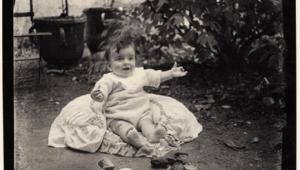
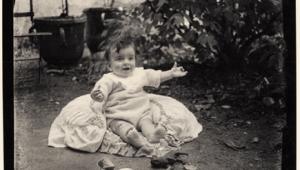
is grown up…I have a baby picture of my father taken in 1914. It
still looks good. I have a tintype of my grandmother as a baby, taken
in perhaps 1885. I also have a carte de visite picture of a relative who
died in Andersonville prison camp in 1863.
Will there be an archive of the early 21st century? Digital cameras are
great because you can wipe out any unwanted pictures without paying to
have them printed. It saves a lot of money and a lot of time. But how
many of those pictures which are wiped out could be a precious record
of a child’s early years, or a special family get-together, or even
an important historical event?
The computer industry thinks in the short term. Are they actually going
to make sure that digital photographic technology advances in such a way
that you will be able to read your CD-ROMs in 20 years? Thirty years?
Fifty years? I have a collection of copy negatives courtesy of the War
College in Carlisle, Pennsylvania. I can go into my darkroom and print
a picture of Ulysses S. Grant, or “Stonewall” Jackson. Will
anyone be able to print a picture of George “Dubbya” Bush
from a CD in 140 years? Will they be able to copy the CD? Or even read
it?
This archive is the great advantage of silver halide photography. This
is why we need to value it, and start regarding it as an alternative process.
It is our past, and our future. There is no alternative to either.
|
 |
|
 |
|
|
 |
 |
 |
|